
15 July 2026 · Medows · Dr. Soumyadeep Adhikari · PGT General Medicine, RG Kar Medical College
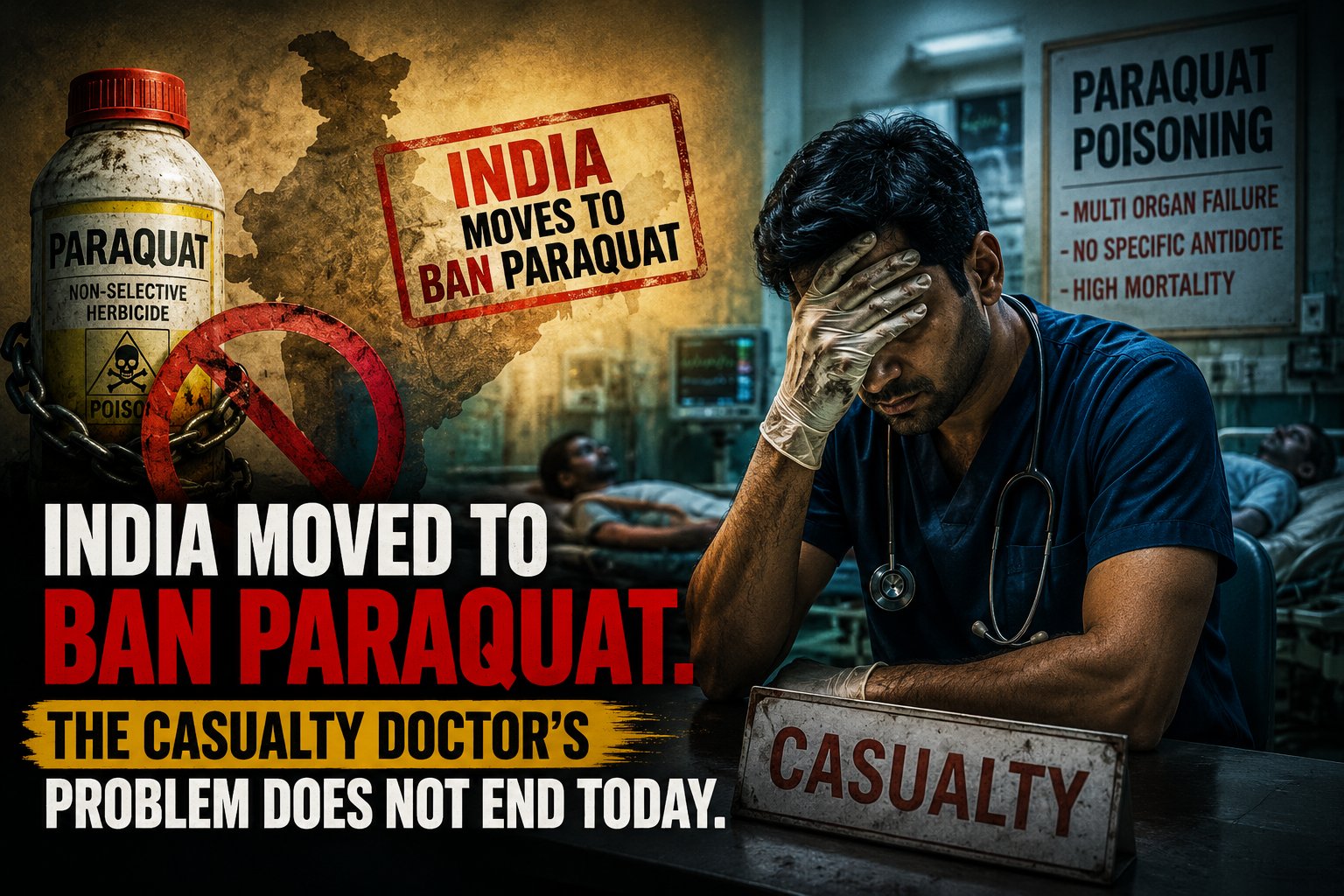
India moved to ban paraquat. The casualty doctor's problem does not end today.
India issued a draft order to ban paraquat on 13 July. It is not final yet, and the patient who walks into casualty tonight still has no antidote.

Dr. Soumyadeep Adhikari, MBBS, MD
PGT General Medicine, RG Kar Medical College
On 13 July 2026, the Ministry of Agriculture and Farmers Welfare published the draft
Banning of Paraquat Dichloride Order, 2026 in the Gazette of India. It proposes a
complete ban on the manufacture, import, transport, distribution, sale and use of
paraquat dichloride.
First, a correction worth making, because several headlines got it wrong. This is a
draft order, not a final one. It is open for public comment for 30 days before the
Centre takes a final decision. Paraquat is not banned in India today. If you are the
doctor on casualty tonight, nothing about your next paraquat case has changed.
Why the regulator moved
The order follows an Expert Committee constituted on 14 January 2026, which submitted
its report on 12 June 2026. The Registration Committee's reasoning is worth reading
closely, because it is unusually clinical for an agriculture notification. It cited:
- Paraquat is already banned or severely restricted in more than 70 countries.
- Documented adverse health effects and continued poisoning incidents resulting in
high fatalities. - The absence of a specific antidote.
That last line is the whole story. Regulators do not usually ban a compound because
medicine cannot treat it. Here they did, and they were right to.
What "no antidote" actually means at the bedside
We wrote about this in detail in
The Slow Goodbye,
and the short version is the part that makes paraquat so cruel:
The patient often walks in talking. Early on they can look deceptively well, which is
exactly what makes the case so dangerous for a busy casualty. There is no reversal
agent to give. Management is supportive and decontamination is time-critical, and even
when everything is done correctly, the lungs can quietly fibrose over the following
days and weeks. The death arrives long after the bottle is empty.
That is why prevention upstream, at the level of what is legally available to buy, does
more good than anything we can offer downstream at 2 a.m.
What changes, and what does not
If the order is finalised, registration holders will have to surrender their
certificates within three months, and all registrations granted under Section 9 of the
Insecticides Act will be cancelled from the date it comes into force. Enforcement will
sit with state governments.
But be realistic about the timeline. A 30-day comment window, then a final order, then
a three-month surrender period, then state-level enforcement, then existing stock still
sitting in sheds and shops. Doctors in Indian casualties will be seeing paraquat for
years after the ink dries.
So the clinical job is unchanged and remains what it always was: recognise it early,
decontaminate fast, resist the false reassurance of a patient who looks fine, and be
honest with the family about what is coming.
The part worth sitting with
This is a good decision, and it is a rare one: a regulator explicitly acting because
medicine has no answer. Most patient safety work asks clinicians to be better at
catching things. This one removes the thing.
Both halves matter. Policy decides how many of these patients arrive. The ward decides
what happens to the ones who still do.
Sources: The Hindu,
India Today,
The Hindu BusinessLine,
Business Standard.
Author
Dr. Soumyadeep Adhikari, MBBS, MD
PGT General Medicine, RG Kar Medical College
MBBS from Calcutta Medical College. Currently a post-graduate trainee in General Medicine at RG Kar Medical College, Kolkata.
Medows is a clinical AI workspace for the doctor on rounds. Learn more or write to alapan@medows.ai / alapanx@gmail.com.