
24 June 2026 · Medows · Dr. Soumyadeep Adhikari & Alapan Mondal
The Slow Goodbye: Why Paraquat Poisoning Kills Long After the Bottle Is Empty
A weed-killer with no antidote, a patient who walks in talking, and a death that arrives weeks later as the lungs quietly turn to scar.


Dr. Soumyadeep Adhikari, Alapan Mondal
2 authors
There is a particular kind of tragedy in medicine that does not announce itself loudly. A young person walks into an emergency department, often able to talk, sometimes with nothing more than a sore mouth and some vomiting. Their vital signs look reasonable. And the doctor standing in front of them, if they recognise what has been swallowed, already knows how the story is likely to end. This is the quiet horror of paraquat.
Paraquat is a herbicide — a weed-killer — and one of the most effective ever made. It is also one of the most lethal poisons a human being can swallow. A mouthful of the concentrated solution is frequently enough to cause death, and there is no antidote. None. In an era where we have reversal agents for opioids, chelators for metals, and antitoxins for snake venom, paraquat remains a substance we can barely fight once it is inside the body. We can only watch, support, and too often, lose.
A poison that turns the body's own chemistry against it
What makes paraquat so uniquely cruel is the elegance of its destruction. Inside cells, it enters a relentless loop chemists call redox cycling. The molecule accepts an electron, then hands it straight to oxygen, generating a storm of reactive oxygen species — the same kind of free radicals that antioxidants are supposed to mop up. Except here the storm never stops. It burns through the cell's reserves of NADPH, shreds the fatty membranes that hold cells together, and leaves a trail of dead and dying tissue.
The organs that suffer most are the ones richest in blood flow and oxygen: the kidneys, the liver, and above all, the lungs. The kidneys are usually first to fail, which is doubly dangerous because they are also the body's main route for clearing the poison. As they shut down, paraquat lingers longer, and the cycle tightens.
But the lung is the real battleground, and it is where paraquat reveals its most sinister trick.
Why the lungs become the killing field
Lung cells possess a transport system meant to ferry beneficial molecules called polyamines across their membranes. Paraquat, by an accident of molecular shape, is mistaken for one of these and actively pulled inside. The result is that the lung concentrates paraquat to many times the level found in the bloodstream. The very machinery designed to nourish the tissue becomes the instrument of its poisoning.
Lung injury then unfolds in two acts. The first is a destructive phase: the delicate lining of the air sacs swells, fragments, and floods. On a CT scan in the first week, this shows up as hazy "ground-glass" shadows, usually creeping in from the edges of the lungs. If those shadows are extensive, the outlook is grim.
The second act is the one that gives paraquat its signature. In the patients who survive the initial onslaught, the body attempts to repair the damage — and overshoots catastrophically. Fibroblasts pour in, collagen is laid down, and the soft, springy tissue of the lung is replaced by stiff scar. This is pulmonary fibrosis. Over the following weeks, the ground-glass haze hardens into dense scarring, and a person who appeared to be recovering begins, slowly, to suffocate. Their lungs simply lose the ability to move oxygen into the blood. It is a death that can take a fortnight or more to arrive, and the patient is often awake to feel it coming.
This is the paradox at the centre of paraquat poisoning, and the reason it deserves special attention: the early phase can lull everyone into false hope, while the fibrosis quietly seals the outcome.
The numbers are as bleak as the story
Studies from hospitals across India and the rest of South Asia tell a consistent and sobering story. Case-fatality rates commonly run from around half of all patients to well over eighty percent, depending on how much was swallowed and how concentrated it was. The dilute formulations are far less deadly than the concentrated ones — a distinction that turns out to matter enormously for prevention.
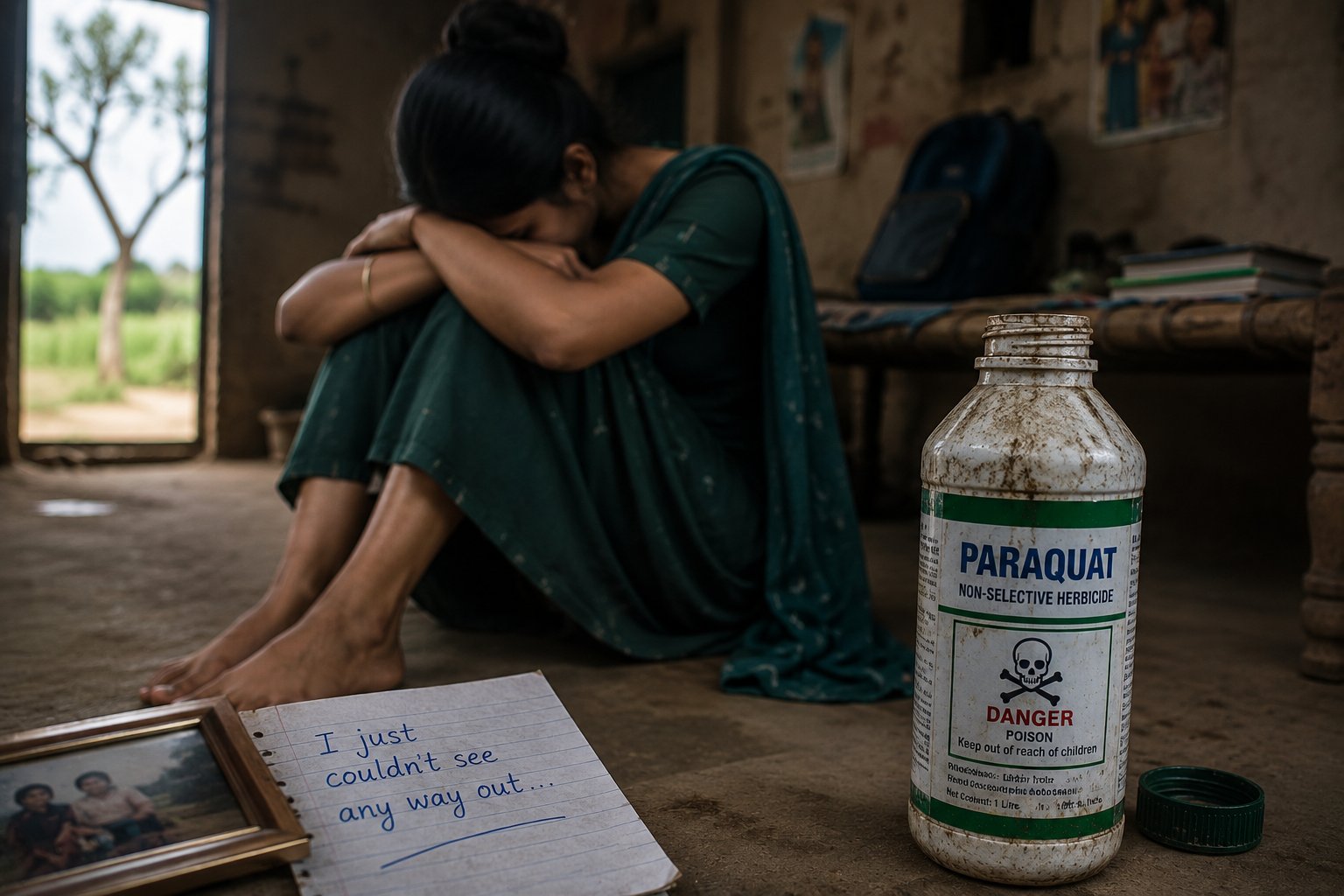
Most of these deaths are not accidents. Paraquat poisoning is overwhelmingly a problem of intentional self-harm, and it is concentrated in rural farming communities where the chemical is cheap, ubiquitous, and stored within easy reach. It is a tragedy that sits at the intersection of agriculture, mental health, and inadequate regulation. The people who die are disproportionately young.
Because doctors can do so little once the poison is absorbed, a great deal of clinical effort goes into prognosis — into honestly estimating who has a chance. The amount ingested and the time before reaching care matter most. A simple bedside urine test (the dithionite test) confirms exposure. Where laboratories allow, the plasma paraquat level and a measure called the Severity Index of Paraquat Poisoning sharpen the prediction. Rising creatinine, a body turning acidic, low potassium, a high white-cell count — each shifts the odds further toward death. None of these tools change the outcome. They change only how clearly we can see it coming, which has its own painful value when families need the truth.
What we can and cannot do
The treatments that exist are mostly attempts to limit absorption and dampen the inflammatory fire. Adsorbents like Fuller's earth or activated charcoal, given early, try to bind the poison in the gut. Blood-cleansing techniques such as haemoperfusion aim to pull it out of circulation. Immune-suppressing drugs and antioxidants have been tried for years, and the evidence remains stubbornly inconclusive — perhaps a small benefit in a narrow band of patients, perhaps not. There is also a counterintuitive rule that surprises many: giving extra oxygen can actually make things worse, because oxygen is the very fuel of paraquat's destructive cycle. Oxygen is withheld unless the patient is genuinely starved of it.
The honest summary is that medicine's most powerful response to paraquat is not treatment at all. It is prevention.
The lesson Sri Lanka taught the region
Here is the part of the story that should give us hope rather than despair. The most dramatic reductions in paraquat deaths have come not from any breakthrough in the intensive care unit, but from keeping the poison out of people's hands in the first place. When countries have restricted the most lethal pesticide formulations, or banned them outright, suicide rates have fallen — without farmers losing their livelihoods, because alternatives exist. Regulation, dull as it sounds, has saved more lives than any drug.
That is ultimately why studying mortality in paraquat poisoning matters, and why lung fibrosis sits at the heart of it. Every careful audit of who dies, when, and from what, builds the case for action. It tells emergency physicians how to counsel a frightened family with honesty. It tells public-health authorities exactly what a bottle on a shelf is worth in human lives. And it keeps insisting on a truth that is easy to forget in a busy ward: the most treatable thing about paraquat poisoning is making sure it never happens.
If you or someone you know is struggling with thoughts of self-harm, please reach out to a local mental-health professional or a crisis helpline. These feelings are treatable, and help is available.
This article is intended for general information and education. It is not a substitute for professional medical advice.
Authors
Dr. Soumyadeep Adhikari, MBBS, MD
PGT General Medicine, RG Kar Medical College
MBBS from Calcutta Medical College. Currently a post-graduate trainee in General Medicine at RG Kar Medical College, Kolkata.
Alapan Mondal, B.Tech, M.Tech, IIT BBS
Founder, Medows
Founder of Medows. Building doctor-side AI workspaces.
Medows is a clinical AI workspace for the doctor on rounds. Learn more or write to alapan@medows.ai / alapanx@gmail.com.