
27 June 2026 · Medows · Alapan Mondal · Founder, Medows
Why handover defaults to WhatsApp, not email
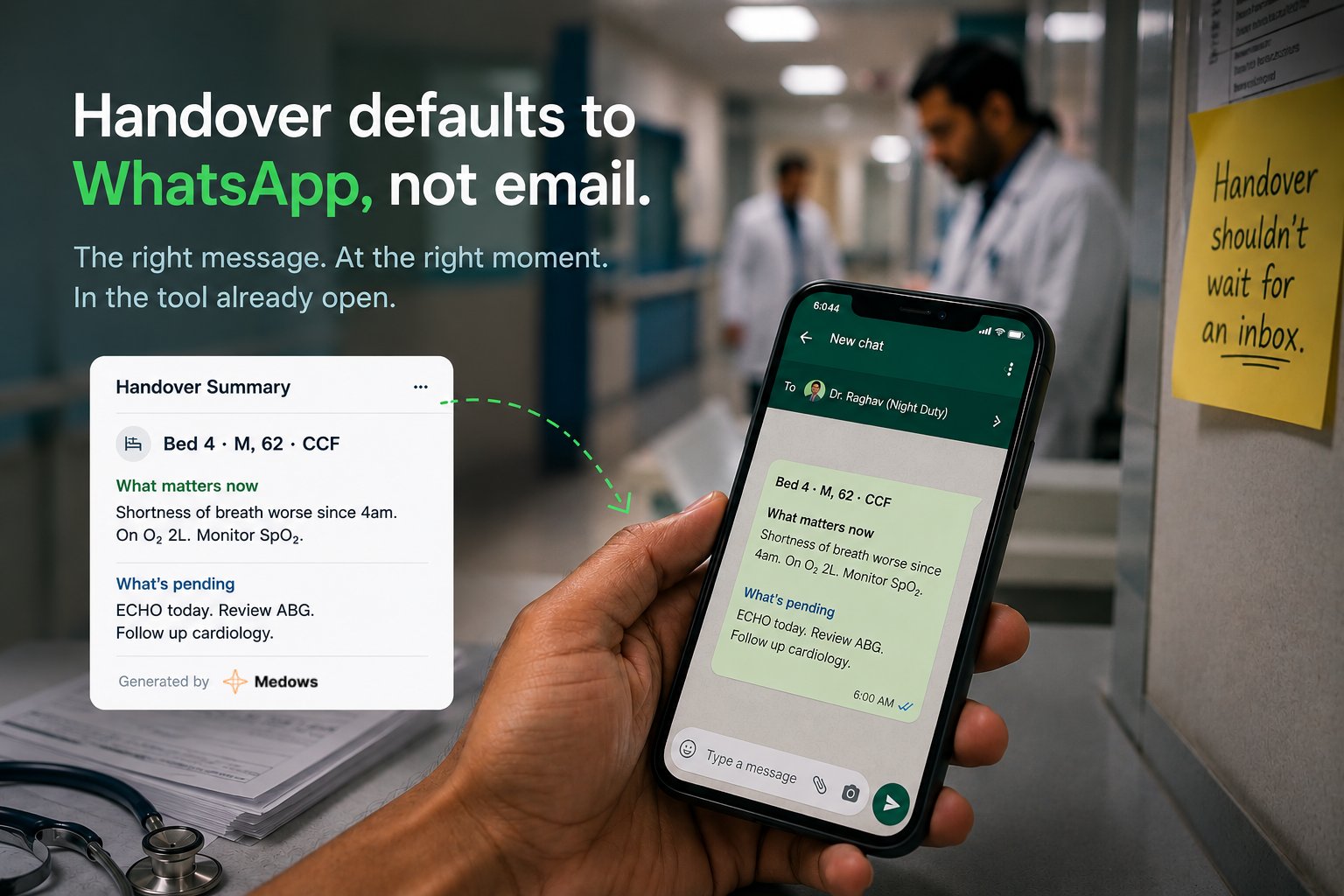
We send handover over WhatsApp because the doctor on the receiving end already has it open. The whole story what it costs us, what we considered, and what would change our mind.

Alapan Mondal, B.Tech, M.Tech, IIT BBS
Founder, Medows
We send handover over WhatsApp. The doctor on the receiving end already
has it open. That's Why handover defaults to WhatsApp, not emailthe whole story — but here's what it costs us, what
we considered, and what we'd reconsider.
The conventional choice was email.
Every clinical workflow tool that ships in 2026 with a "handover" feature
defaults to either email or a notification inside its own app. Email is
what hospital administrators expect; in-app messaging is what software
vendors prefer, because it keeps users in the product. Both are correct
in some sense. Both miss the actual moment of handover.
Picture the moment. It's 6:00 a.m. The outgoing doctor has been awake for
sixteen hours. The incoming doctor walked into the ward eight minutes
ago, hasn't had chai, and is already being pulled aside about Bed 4.
They are not opening their inbox. They are not signing into another app.
What they have open — what every junior doctor in an Indian government
hospital has open at all times — is WhatsApp.
 ## What we did instead.
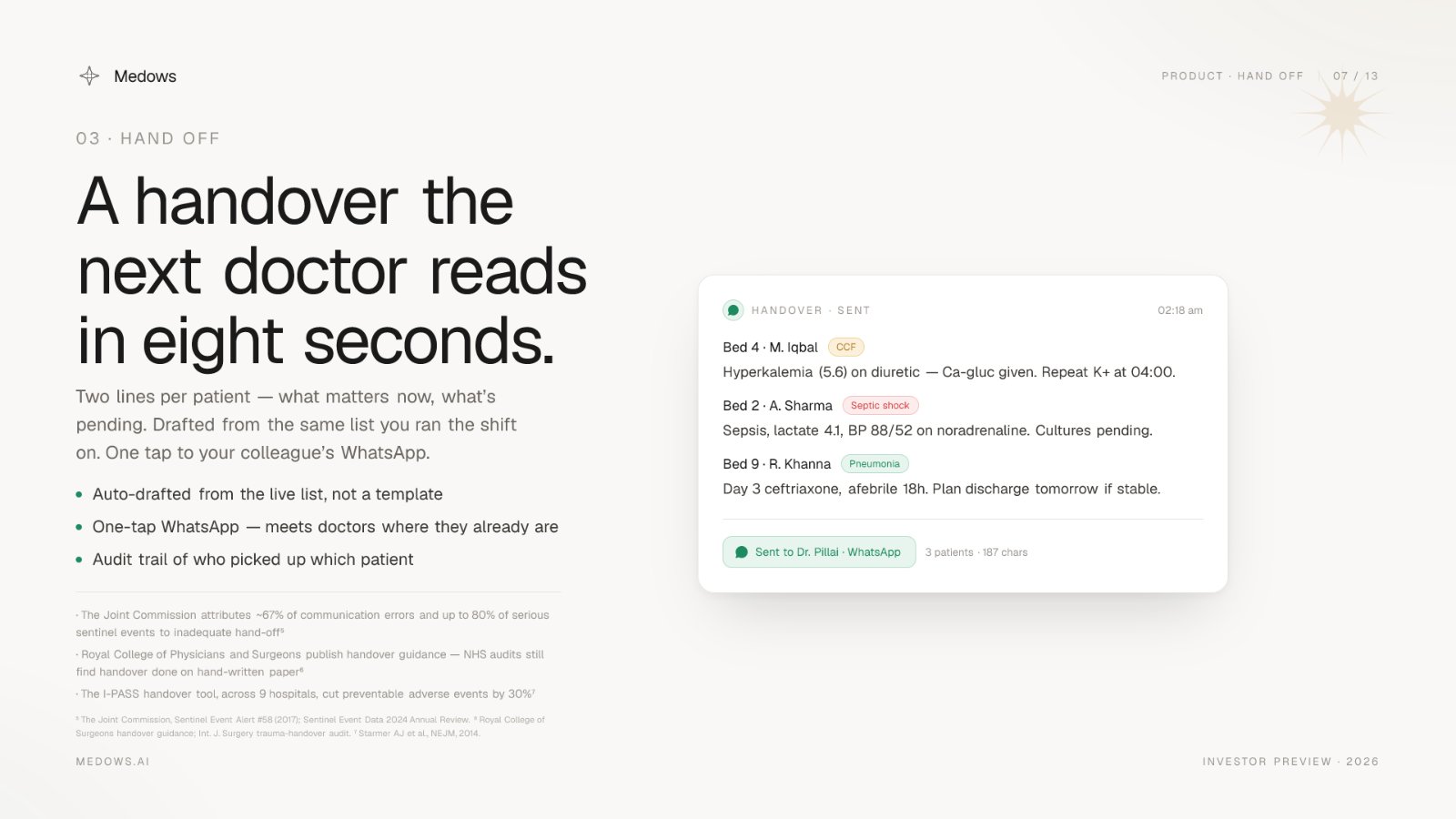
When a doctor taps "Hand off" on a patient card, Medows generates two
lines (what matters now, what's pending), opens WhatsApp on their phone
with the message pre-filled, and waits for them to pick a contact or a
group. That's it. The receiving doctor reads the handover from inside
the chat thread they were already in.
We added one structural detail: the patient identifier is short — Bed 4 · M, 62 · CCF — so the next morning, the receiving doctor can scroll
the chat and see, in order, which beds had unfinished business overnight.
Handovers become searchable by bed number even though we don't run that
search ourselves. WhatsApp does.
The principle.
At shift change, the right tool is the one already open. Anything
that asks the receiving doctor to switch contexts — open another app,
sign in, click a notification, find their email — is a tax on the
handover. The tax is paid in seconds, but in those seconds the next
patient is calling for them.
What we'd reconsider.
Three conditions would change this default.
Markets where WhatsApp isn't the dominant clinical channel. US
hospitals run on Epic chat or institutional email. UK NHS teams use
NHSmail or Microsoft Teams. If we expand into those, "WhatsApp by
default" stops being right; we'd detect the institutional context and
swap the rail.
Hospital partnerships that require formal audit trails. Today, the
doctor's WhatsApp history is their record of what was handed over. That
works for personal use. For a hospital that wants compliance logging —
who handed over what, when, to whom — we'd either log the handover
server-side as it's sent, or move to an in-app channel the institution
can inspect.
Regulatory pressure on PHI over consumer messaging apps. WhatsApp is
end-to-end encrypted, but it's still a consumer product, and some
jurisdictions treat it as non-compliant for patient data even when the
data is minimal — a bed number, an age, a one-line clinical summary. If
a regulator says no, the default flips.
For now, none of those conditions apply to the doctors we build with.
They are on WhatsApp. The handover gets read. The next patient gets
seen. That is the result Medows exists for — and the rest is engineering
preference.
This is the first in a series called Decisions — one product
choice per post, with the principle that drove it. Read more in the
Product topic.
Author
Alapan Mondal, B.Tech, M.Tech, IIT BBS
Founder, Medows
Founder of Medows. Building doctor-side AI workspaces.
Medows is a clinical AI workspace for the doctor on rounds. Learn more or write to alapan@medows.ai / alapanx@gmail.com.