
24 June 2026 · Medows · Alapan Mondal · Founder, Medows
Why Doctors Need a Workspace of Their Own
Five studies on how junior doctors actually spend their time, what handover failure costs in serious adverse events, and why the ward is the only part of modern healthcare still running on paper and memory.

Alapan Mondal, B.Tech, M.Tech, IIT BBS
Founder, Medows
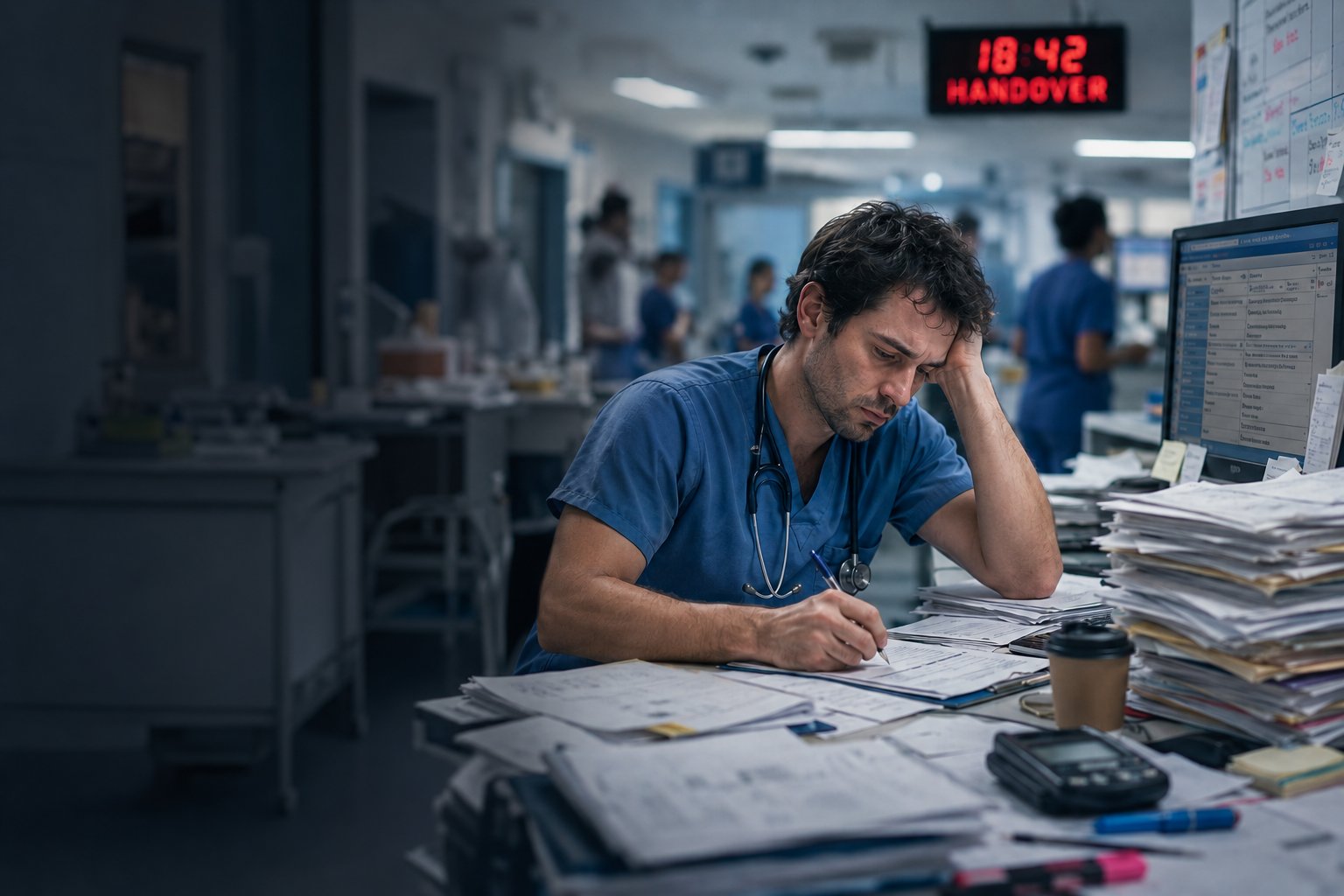
A few months back I started reading the published research on what hospital doctors — specifically residents and ward-based clinicians — actually do during a shift. Not the textbook version. The real time-motion studies, the interruption-density papers, the handoff-error data.
I expected the picture to be ugly. It's worse.
What follows are five findings that I keep coming back to, and the one that ties them together: the doctor on the ward is the only person in modern healthcare without software designed for what they actually do.
1. Doctors spend more time on documentation than on patients
Sinsky and colleagues ran a four-specialty time-motion study on US physicians in ambulatory practice (Annals of Internal Medicine, 2016). The result was the now-famous "two-to-one" finding: 49.2% of the workday on EHR and desk work, 27.0% on direct patient face time. For every hour with a patient, two hours on the computer.
Arndt and colleagues went further the year after (Annals of Family Medicine, 2017), tracking actual EHR event logs of 142 primary care physicians. The average doctor's workday was 11.4 hours, of which 5.9 hours on the EHR — including 1.4 hours of "pajama time" after the workday officially ended.
No equivalent rigorous time-motion study has been published for Indian government hospital residents, but the residents I've spoken to describe the same ratio with worse total hours and less of it on a screen. The documentation just moves to paper, photocopied lists, and WhatsApp.
2. They're interrupted constantly
Tipping and colleagues shadowed US hospitalists for a day (Journal of Hospital Medicine, 2010) and found they were interrupted roughly once every nine minutes. The cognitive cost is non-trivial: typical recovery time before returning to the original task is 23 seconds in the easiest scenarios. Full re-engagement with complex clinical reasoning takes much longer.
Westbrook and colleagues focused on the dose-response curve (BMJ Quality & Safety, 2010). They found that for ward nurses, each interruption during medication administration was associated with a 12.7% increase in clinical error rate. Just four interruptions roughly doubled the rate of major errors.
The implication for a resident on admission day is not subtle. You're not being asked to make twenty-five sequential clinical decisions in calm sequence. You're being asked to make them in a stream of constant interruptions, on the same brain.
3. Handover failure is the cause of most serious adverse events
The Joint Commission has analysed sentinel events for two decades. Communication and handoff failures contribute to roughly 70–80% of serious adverse events — wrong-site surgery, medication errors, missed diagnoses, deaths from deterioration that wasn't escalated.
The intervention literature here is unusually clear. Starmer and colleagues implemented a standardised handoff bundle called I-PASS across nine pediatric residency programs (NEJM, 2014). Within a year: 23% reduction in medical errors. 30% reduction in preventable adverse events. Same staff, same patients, just a better handover protocol.
The thing to sit with is this: the intervention that produced the largest published reduction in preventable patient harm in a generation was a structured handover protocol. And yet the actual handover, in most hospitals globally, still happens on a folded sheet of paper at 2 a.m. or as voice notes in a WhatsApp group.
4. The Indian context multiplies all of the above
India's national doctor-to-population ratio is roughly 1:1,000 (National Medical Commission, 2023). That sounds tolerable until you look at distribution. Tertiary government hospitals see catchment populations of 3–5 million through 200-bed wards. The on-the-ground reality residents describe:
- Most teaching hospitals run admission days where a single resident takes 20–30 new admissions in a 12-hour shift.
- 80–100+ hour work weeks during admission rotations (multiple AIIMS and JIPMER cohort studies; widely reported, less rigorously measured than US workforce data).
- Burnout rates of 40–60% in published Indian resident cohorts, depending on speciality and institution.
If documentation overhead is bad in the American studies, it's worse here. The Indian resident isn't replacing paper with EHR clicks; they're replacing memory with paper, paper with WhatsApp, and WhatsApp with a frayed list in a coat pocket.
5. The ward is the only part of modern healthcare without software designed for it
This is the thread that runs through everything above. Modern healthcare has been progressively softwared:
- EHRs for documentation (Epic, Cerner, eClinicalWorks)
- Open-web clinical search engines for clinical questions (OpenEvidence, UpToDate, Glass Health)
- AI scribes for outpatient consultation transcription (Abridge, Nuance DAX, Suki)
- Imaging AI for radiology read assistance
- Patient portals for patient-side communication and access to records
- ICU monitoring systems with real-time alerts on continuous vitals
- Pharmacy systems with interaction-checking at the prescribing step
But the doctor walking a ward at 2 a.m. with 28 patients in working memory has no purpose-built surface for the work in front of them.
They have an EHR — but that's a documentation database, not a thinking surface, and it's optimised for billing and compliance, not for the doctor on rounds. They have search engines — but those have no idea which patient is on the screen. They have paper. They have WhatsApp. They have memory.
It is a strange gap to leave open.
Why this is what we're building
The reason Medows exists is that gap. We didn't set out to build another EHR — there are already several, the market is solved, and the doctor-on-rounds problem is not a documentation problem. We didn't set out to build another clinical search engine — those exist too, and they're useful, and they have no idea who the doctor is looking at.
We set out to build a workspace for the doctor on rounds:
- A patient list that holds the shift — vitals, complaints, active orders, lab values, ECG photos — at the level of detail a doctor would otherwise carry on paper.
- An AI consult that already knows which patient is on the screen, because it shares context with the list. The doctor doesn't restate the case. The answer is in the patient's units.
- A handover that composes itself from the actual events of the shift, so the pending lab and the half-resolved K+ don't disappear into a folded sheet at 2 a.m.
It is not a hospital tool. It is a personal one — scoped to the individual doctor's account, with no admin dashboard and no audit log a hospital can pull. We picked that on purpose. The surface should belong to the person doing the work.
We are free for individual clinicians. The product is still finding its shape; the doctors using it now are mostly residents at Indian government medical colleges. If that's you, try it on your next shift at medows.ai.
And if you are a doctor or a researcher with data or perspective on any of the studies above — or with corrections, or with stories from your own wards — I'd genuinely like to hear. Write to alapanx@gmail.com, or co-author a follow-up post here. The blog is open to bylines from doctors at any stage.
References
- Sinsky CA, Colligan L, Li L, et al. Ann Intern Med. 2016;165(11):753-760. PMID: 27595430
- Arndt BG, Beasley JW, Watkinson MD, et al. Ann Fam Med. 2017;15(5):419-426. PMID: 28893811
- Tipping MD, Forth VE, O'Leary KJ, et al. J Hosp Med. 2010;5(6):323-8. PMID: 20533571
- Westbrook JI, Woods A, Rob MI, Dunsmuir WT, Day RO. BMJ Qual Saf. 2010;19(4):284-9. PMID: 20445188
- Starmer AJ, Spector ND, Srivastava R, et al. N Engl J Med. 2014;371(19):1803-12. PMID: 25372088
- Joint Commission. Sentinel Event Statistics, Quarterly Data Reports.
- National Medical Commission of India. Annual Report 2023.
Author
Alapan Mondal, B.Tech, M.Tech, IIT BBS
Founder, Medows
Founder of Medows. Building doctor-side AI workspaces.
Medows is a clinical AI workspace for the doctor on rounds. Learn more or write to alapan@medows.ai / alapanx@gmail.com.