

20 August 2026 · Medows · Dr. Susmita Maji · Junior Resident, Paediatrics, B. C. Roy Hospital
The CSF that did not fit
A CSF report with 920 cells and 92% polymorphs and a glucose and protein that both read normal. What antibiotics can and can't explain before the next lumbar puncture.

Dr. Susmita Maji, MBBS, JR, Paediatrics
Junior Resident, Paediatrics, B. C. Roy Hospital
Nine hundred and twenty cells per microlitre. Ninety-two percent polymorphs. That is the kind of cerebrospinal fluid report that makes the decision for you. You don't debate it, you start meropenem and you move to the next task on the list.
Then you get to the bottom of the form. Sugar, 103. Protein, 29.
Those two numbers should not be sitting next to that cell count, and for about a day, I didn't know what to do with the disagreement between them.
The case
A seven-year-old girl was brought in with two days of fever, two days of headache, and a day of worsening consciousness. She was pale enough on examination that a haemoglobin was sent before anything else, and it came back at 3.3 g/dL. Her spleen and liver were both palpable. Within hours she was intubated for a falling GCS, and by evening she was in the paediatric ICU on ceftriaxone, vancomycin, acyclovir and doxycycline: the standard first-hour cover for a child who might have bacterial meningitis, viral encephalitis, or a rickettsial illness, because at that point you are not choosing between them, you are covering all three until something tells you otherwise.
The lumbar puncture was done on day 2, after three doses of each antibiotic had already been given. That detail turns out to matter more than anything else in this post.
CSF report:
| Parameter | Value |
|---|---|
| Appearance | Clear, colourless |
| Total cell count | 920 cells/µL |
| Polymorphs | 91.7% (844/µL) |
| Mononuclear cells | 8.3% (76/µL) |
| Glucose | 103 mg/dL |
| Pre-LP capillary glucose | 167 mg/dL |
| Protein | 29 mg/dL |
| Culture | No growth after 48 hours' aerobic incubation |
The cell count and the neutrophil predominance are unambiguous. The glucose and the protein are not just unremarkable, they are normal. A CSF-to-blood glucose ratio of 0.62 is well above the 0.4 that bacterial meningitis classically drops below, and a protein of 29 mg/dL is inside the normal range, not just outside the markedly-elevated range you'd expect with 920 white cells.
Here is what that looks like set against the teaching ranges I was taught on the wards:
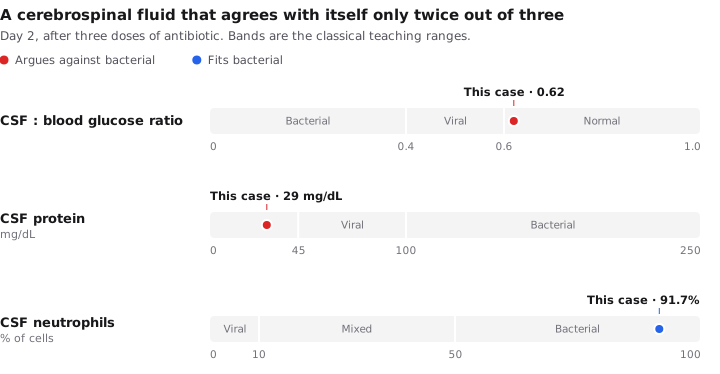
Two of the three measures argue against bacterial meningitis. Only the neutrophil predominance fits it. Bands are the classical teaching ranges.
What antibiotics do to a CSF report
The instinctive explanation, the one I reached for first, is that three doses of antibiotics before the tap had already started cleaning up the fluid. That's a real phenomenon, and it's worth knowing the shape of it rather than just gesturing at it.
Nigrovic and colleagues looked at 245 children with confirmed bacterial meningitis, of whom about a third had received antibiotics before their LP. Compared with untreated children, at least twelve hours of pretreatment was associated with a higher median CSF glucose (48 mg/dL vs 29 mg/dL) and a lower median protein (121 mg/dL vs 178 mg/dL), while the white cell count and the absolute neutrophil count were essentially unchanged between the two groups.¹ That is exactly the direction of what I was looking at: chemistry drifting toward normal, cytology staying put.
But look at the actual numbers again. Nigrovic's pretreated children still had a median protein of 121 mg/dL, clearly elevated. Ours was 29. Pretreatment shifts the chemistry; it does not, on the evidence I could find, produce a CSF that reads as flatly normal on both fronts. So "she'd already had antibiotics" is a partial answer. It is not the whole one, and I want to be honest about that rather than write it up as solved.
Culture sterility is easier to account for. Kanegaye and colleagues found that meningococcal CSF cultures can turn negative within about two hours of the first parenteral dose, with pneumococcus and group B strep persisting a little longer, up to roughly four hours.² Three days in, a sterile culture tells you almost nothing about whether bacteria were there.
Why the score I'd normally reach for doesn't apply here
If you trained anywhere near a paediatric emergency department, you've probably been taught some version of the Bacterial Meningitis Score (Gram stain, CSF ANC, CSF protein, peripheral ANC, seizure at presentation) as a way of deciding which febrile child with CSF pleocytosis can skip empirical antibiotics.³ It's a genuinely good rule, with a sensitivity above 98% in its validation cohort of over 3,000 children.
It also does not apply to this child, and it's worth being precise about why, because the reasons are the same reasons her CSF doesn't read cleanly. The rule's derivation explicitly excluded any child who had received antibiotics in the 72 hours before the LP, and separately excluded any child who was critically ill: severely altered consciousness, needing respiratory or blood pressure support. She met both exclusion criteria on her own. The authors were not being cautious for no reason: pretreatment and critical illness are exactly the two things that make a CSF report stop behaving the way the textbook describes.
What would have actually settled it
Three things could have taken this from "probably bacterial, on balance" to something firmer, and none of them were sent.
A CSF multiplex PCR panel picks up bacterial, viral and some parasitic targets from the same sample, and unlike culture it doesn't need live organisms to work. The best current evidence, a meta-analysis across 19 studies and over 11,000 patients, puts pooled sensitivity for bacterial targets at 89.5% and specificity at 97.4%.⁴ That sounds reassuring, but the authors' own framing is the useful part: the panel is good for ruling a pathogen in, and much less reliable for ruling one out, particularly organism by organism: sensitivity for H. influenzae alone dropped to 65%. A negative panel in a pretreated child would not have told me she didn't have bacterial meningitis. It would, however, have told me a great deal if it had come back positive.
Bacterial antigen testing is older technology and the 2004 IDSA guideline is lukewarm about it in general use, but specifically carves out an exception for exactly this situation: a patient already pretreated, with a negative Gram stain and negative culture.⁵ It wasn't sent either.
And a blood culture: ordered on admission according to the chart, but no result filed anywhere in the record. I don't know if it was never drawn, never processed, or simply never returned to the ward. Whichever it is, it's a gap in the record as much as a gap in the diagnosis.
The rule I'm taking from this
None of this means the child was treated wrong. Covering for bacterial meningitis on a CSF like this one is the correct call, and I would make it again tomorrow. What I'd change is what happens at the moment of the tap, not after it.
If a lumbar puncture is being done on a child who has already had antibiotics (which, on a busy ward, is often exactly when it gets done), send an extra sample for PCR at the same time, before the report comes back looking ambiguous and someone has to decide whether it's worth a second, harder LP to get it retrospectively. The cost of drawing three extra millilitres at the first pass is nothing next to the cost of not being sure, five days later, why the child isn't turning a corner.
Clinical details have been altered and dates removed to prevent identification. Laboratory values and treatment are reported as recorded. This account is written for clinical education and is not a substitute for professional medical advice.
References
- Nigrovic LE, Malley R, Macias CG, et al. Effect of antibiotic pretreatment on cerebrospinal fluid profiles of children with bacterial meningitis. Pediatrics. 2008;122(4):726–730.
- Kanegaye JT, Soliemanzadeh P, Bradley JS. Lumbar puncture in pediatric bacterial meningitis: defining the time interval for recovery of cerebrospinal fluid pathogens after parenteral antibiotic pretreatment. Pediatrics. 2001;108(5):1169–1174.
- Nigrovic LE, Kuppermann N, Macias CG, et al. Clinical prediction rule for identifying children with cerebrospinal fluid pleocytosis at very low risk of bacterial meningitis. JAMA. 2007;297(1):52–60.
- Trujillo-Gómez J, Tsokani S, Arango-Ferreira C, et al. BioFire FilmArray Meningitis/Encephalitis panel for the aetiological diagnosis of central nervous system infections: a systematic review and diagnostic test accuracy meta-analysis. eClinicalMedicine. 2022;44:101275.
- Tunkel AR, Hartman BJ, Kaplan SL, et al. Practice guidelines for the management of bacterial meningitis. Clin Infect Dis. 2004;39(9):1267–1284.
Author
Medows is a clinical AI workspace for the doctor on rounds. Learn more or write to alapan@medows.ai / alapanx@gmail.com.