
29 August 2026 · Medows · Dr. Susmita Maji · Junior Resident, Paediatrics, B. C. Roy Hospital
Sodium is a neurological observation
Sodium climbed for a full day after correction started. That's the point where it stopped being a fluids problem.

Dr. Susmita Maji, MBBS, JR, Paediatrics
Junior Resident, Paediatrics, B. C. Roy Hospital
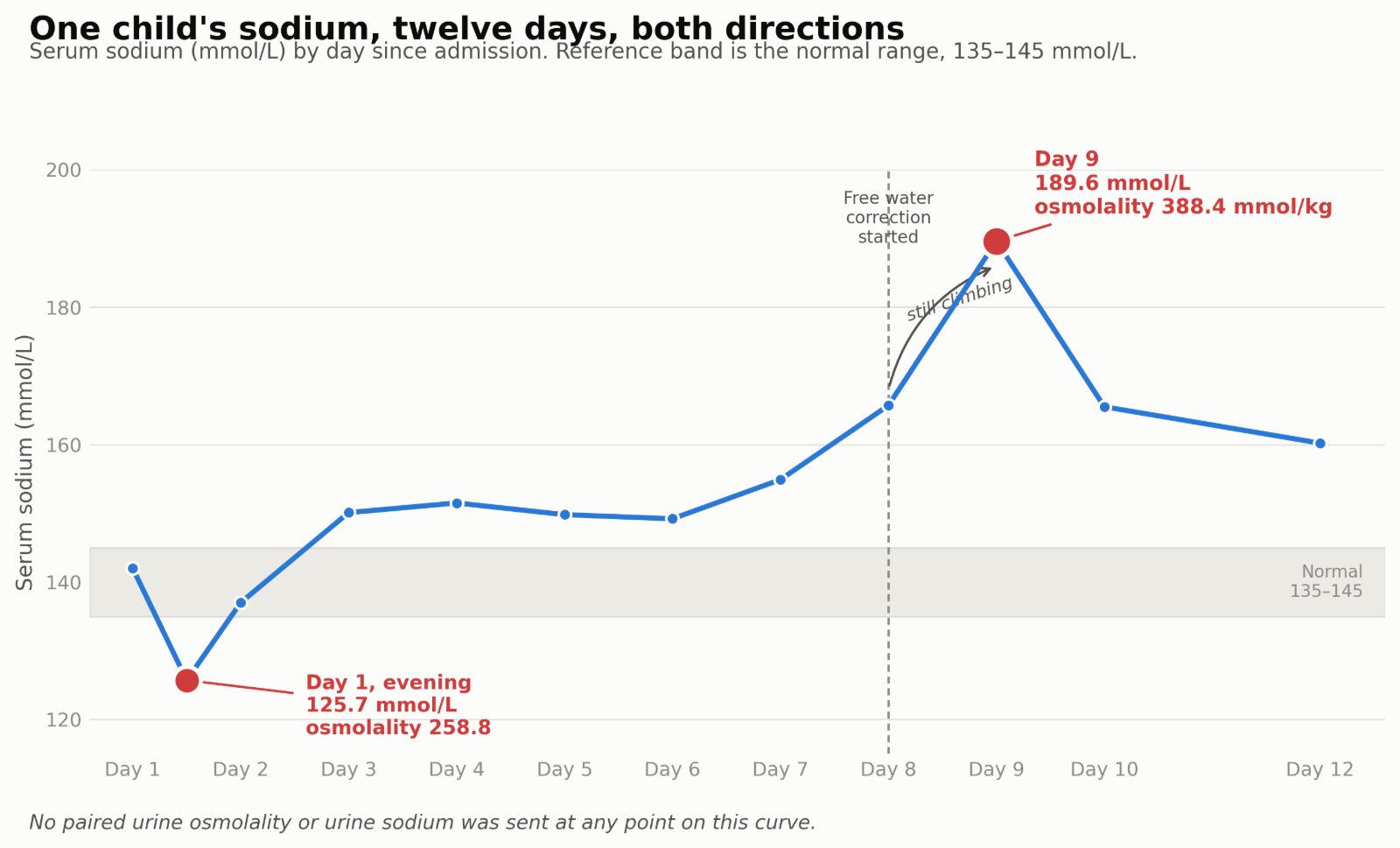
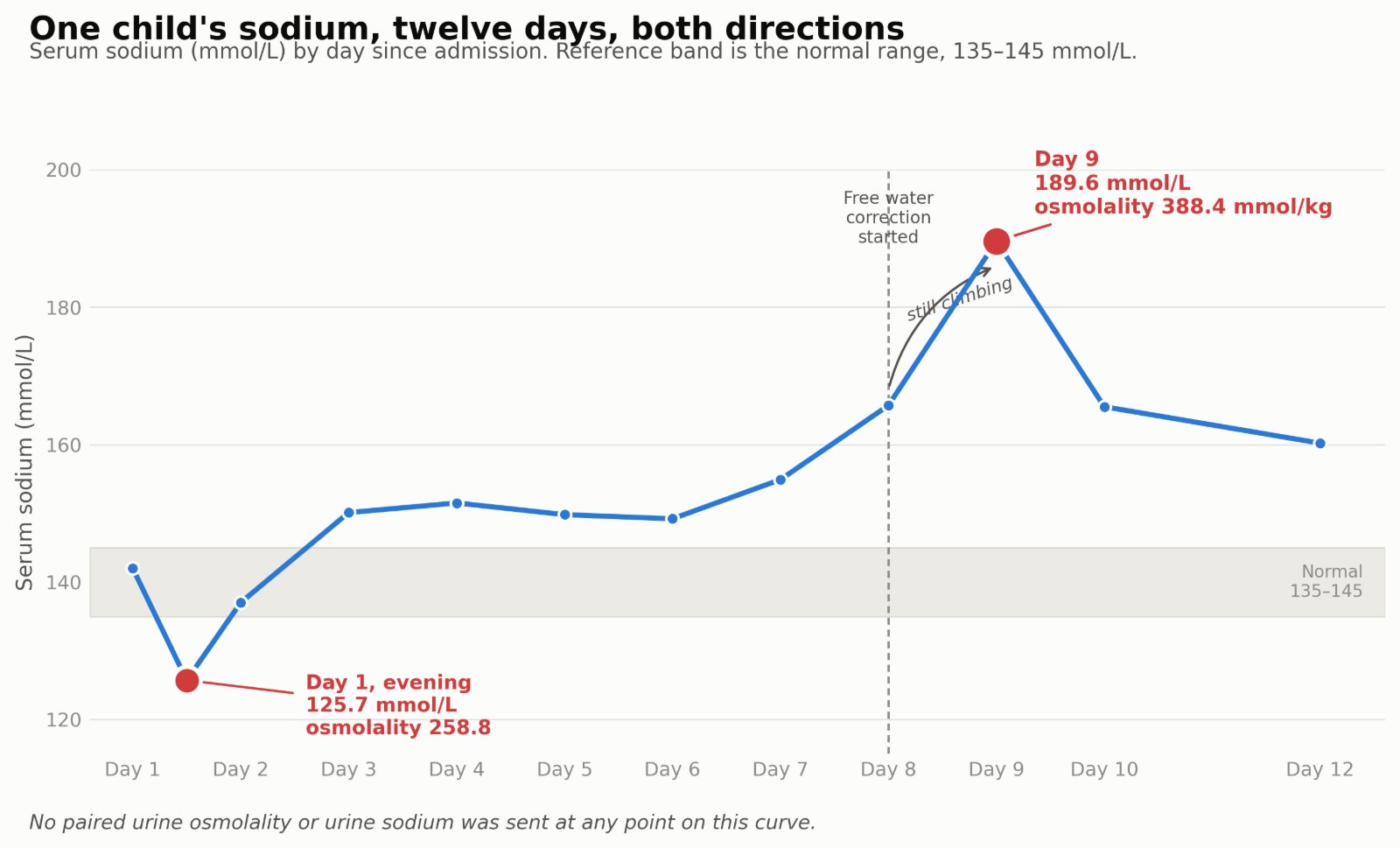
By day nine, her serum sodium was 189.6 mmol/L. The osmolality that came with it was 388.4 mmol/kg. Somewhere in the four days before that number, this stopped being a fluid-balance problem I could fix with a formula, and became a report on what was happening to her brain. I didn't change how I was monitoring it until it was already the second number, not the first.
The whole curve
Twelve days, one child, sodium moving in both directions:
 One child's sodium, twelve days, both directions
On the evening of day one, her sodium was 125.7 mmol/L. Forty-eight hours later it had crossed back into normal. By day nine it had gone almost fifty points past the top of that range in the other direction. If you only remember one thing about hypernatraemia in a sick child, remember that it can start as its opposite, in the same admission, days apart.
Hyponatraemia first, and why the reflex is wrong
The evening-of-day-one number is the one I'd have reflexively treated by restricting fluids, if I'd trained on an older textbook. That reflex is worth retiring. Hyponatraemia is common in bacterial meningitis, not a marker of something having gone especially wrong: in a cohort of 175 children with confirmed bacterial meningitis, 66.4% had a sodium below 135 mmol/L, and it was only the severe end of that group, not hyponatraemia as such, that tracked with shock, organ dysfunction and a worse short-term outcome.¹ Mild hyponatraemia on day one of meningitis is closer to background noise than to a diagnosis.
And restriction is not obviously the right answer even when you do act on it. A Cochrane review of fluid therapy in paediatric bacterial meningitis, pooling three trials in 420 children, found no difference in mortality between maintenance and restricted fluids, but did find restriction associated with more spasticity, more seizures at 72 hours and 14 days, and more chronic severe neurological sequelae at three months.² The evidence is low to very low quality and the review's own conclusion is that it isn't strong enough to mandate a change in practice, but it's strong enough to make me stop reaching for restriction as a first move.
What was actually pushing the number up
Nothing about the rise itself is mysterious once you list what she was on. Three percent saline for suspected raised intracranial pressure. Mannitol, repeated. Nil by mouth for the entire admission, which meant no enteral free water at all. And a urine output that ran high on most days, 2.6 to 4.3 mL/kg/hr, quietly losing more free water than anyone was replacing.
Any one of those explains a sodium in the low 150s. None of them, on their own, explains 189.6.
Where it stops being about fluids
Here is the shift I want to name precisely, because I think it's the actual teaching point. Free water correction started on day eight. Sodium kept climbing anyway, and didn't peak until the following day. At the same time, her serum was hyperosmolar at 388 mmol/kg while her urine stayed dilute, and clinically she had fixed, dilated pupils and no spontaneous respiratory effort. The note from that day reads, in essence: sodium still rising despite free water correction, suggestive of central diabetes insipidus.
That combination, rising sodium that free water can't keep up with, in a child whose brainstem is already in trouble, is not a plumbing problem any more. Serum sodium above 147 mmol/L together with inappropriately dilute urine (osmolality under 300 mOsm/kg) and polyuria above 2 L/m²/day is the diagnostic picture of central diabetes insipidus.³ The most relevant outcome data I could find isn't from meningitis but from paediatric traumatic brain injury, where hypernatraemia above 160 mmol/L carried roughly a six-fold increase in mortality, and the development of central DI was itself independently associated with hypernatraemia.⁴ I want to be careful here: that's a TBI cohort, not an infection cohort, and I haven't found a reliable incidence figure for central DI specifically after paediatric CNS infection. But the mechanism travels, even if the exact numbers don't: a sodium that won't respond to free water, in a neurologically injured child, is telling you about the injury, not about the drip rate.
What never got sent
Nowhere on this curve is there a paired urine osmolality, a urine sodium, or a urine specific gravity. Without them, central DI stayed a clinical impression rather than a confirmed diagnosis, and desmopressin was never started or even formally discussed. I'm not certain it should have been. I am certain the conversation should have happened, with the numbers in front of us rather than without them.
How fast to correct, honestly
I'd like to give you one clean rule for the rate of correction and I can't, because the sources I trust don't agree. NICE's current paediatric IV fluids guideline says the fall or rise in plasma sodium should not exceed 12 mmol/L in any 24-hour period, with electrolytes checked every four to six hours for the first day.⁵ That's the number I was taught, give or take, and it's the one I'd default to. But a more recent single-centre study of 402 hypernatraemia episodes in children found that correcting faster than the traditional 0.5 mmol/L/hour ceiling was not associated with more cerebral oedema, seizures, or death, while correcting slowly was associated with a longer admission.⁶ I've only read that one at abstract level, and a single retrospective cohort shouldn't overturn a standing guideline, but it's evidence that the dogma is softer than it's usually taught, and it's worth knowing that the disagreement exists before you're the one titrating the drip at 2 a.m.
The rule I'm actually taking from this
Not a target number. A trigger point. For any ventilated child on hypertonic saline or mannitol, paired serum and urine osmolality, plus a urine sodium, should enter the standard monitoring set the day the serum sodium first crosses 150 mmol/L, not the day someone finally asks why free water correction isn't working. By day nine, we had the diagnosis in the wrong tense. We were describing what had already happened instead of catching it while it was still happening.
Clinical details have been altered and dates removed to prevent identification. Laboratory values and treatment are reported as recorded. This account is written for clinical education and is not a substitute for professional medical advice.
References
- Zheng F, Ye X, Shi X, Lin Z, Yang Z, Jiang L. Hyponatremia in children with bacterial meningitis. Front Neurol. 2019;10:421.
- Maconochie IK, Bhaumik S. Fluid therapy for acute bacterial meningitis. Cochrane Database Syst Rev. 2016;(11):CD004786.
- Flynn K, Hatfield J, Brown K, Vietor N, Hoang T. Central and nephrogenic diabetes insipidus: updates on diagnosis and management. Front Endocrinol. 2024;15:1479764.
- Alharfi IM, Stewart TC, Kelly SH, Morrison GC, Fraser DD. Hypernatremia is associated with increased risk of mortality in pediatric severe traumatic brain injury. J Neurotrauma. 2013;30(5):361–366.
- National Institute for Health and Care Excellence. Intravenous fluid therapy in children and young people in hospital. NICE guideline NG29.
- Didsbury M, See EJ, Cheng DR, Kausman J, Quinlan C. Correcting hypernatremia in children. Clin J Am Soc Nephrol. 2023;18(3):306–314.
Author
Medows is a clinical AI workspace for the doctor on rounds. Learn more or write to alapan@medows.ai / alapanx@gmail.com.