
14 July 2026 · Medows · Alapan Mondal · Founder, Medows
Medows is launching on Product Hunt
Medows is launching on Product Hunt on July 16: the first AI clinical workspace built for the individual doctor. Walk a real shift in our no-sign-up demo.

Alapan Mondal, B.Tech, M.Tech, IIT BBS
Founder, Medows
Today is a milestone for us: Medows is launching on Product Hunt on 16 July.
If you have followed along, you know the thesis. Every clinical AI tool solves one moment. It drafts a note, answers a question, suggests a code, then hands the patient back and disappears. But a ward round is not one moment. It is forty patients before lunch, vitals half-remembered between beds, and a handover you are already late for. The work is continuous. The tools are not.
So we built something different: the first AI clinical workspace built for the individual doctor, not a hospital rollout you wait months for.
Why "one moment" is the wrong unit
It is worth being concrete about what the one-moment framing costs, because on paper each of those tools is genuinely good at its job.
The scribe writes an excellent note and has no idea that the gas you sent at 11 p.m. has not come back. The question-answering tool gives you a correct answer about hyperkalaemia and cannot tell you it is about the man in Bed 7 rather than a hypothetical. The coding assistant is optimised for a billing system that a government hospital in India does not run.
Each solves its moment and then drops the thread. And the thread is the job — the thing a resident is actually doing all shift is holding state: twenty-eight patients, what changed, what is pending, what to chase, who to tell at 8 p.m. No individual moment-shaped tool can help with that, because the difficulty does not live inside any of the moments. It lives in the gaps between them.
What that means in practice
Medows holds your whole shift in one place:
- One patient list with vitals and trends, labs grouped and flagged, and orders through their real lifecycle (active, awaiting result, resulted).
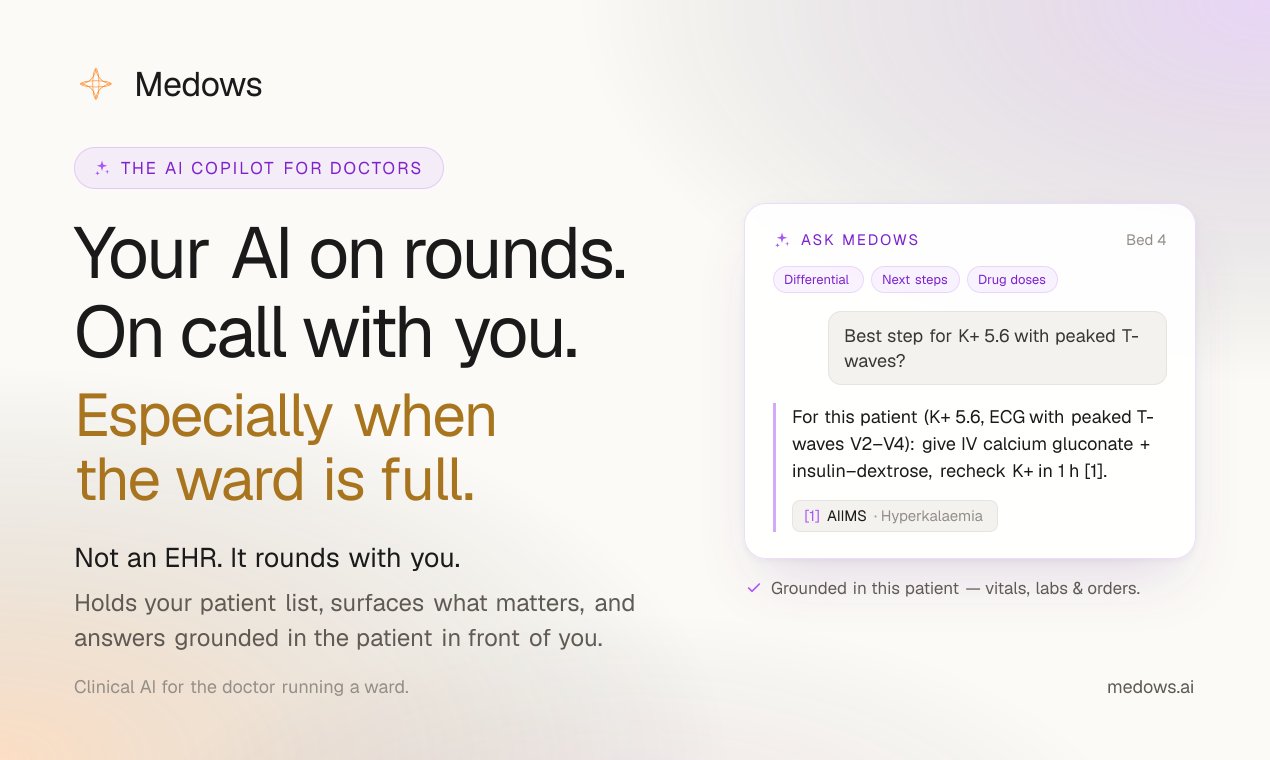
- An AI that already sees what you see, and answers grounded in the actual patient on screen, with inline citations to real guidelines. It shows its sources instead of guessing.
- Handover sent over WhatsApp, because that is where handover actually happens.
Each of those is a deliberate rejection of how clinical software normally works.
The list is sorted by what changed since yesterday, not by bed number — because on a ninety-minute round for twenty-eight patients, the order of the list is the allocation of attention. Orders carry a real lifecycle rather than a checkbox, so "sent, not yet back" is a state the system knows about and can carry into handover instead of a thing you have to remember. The AI cites its sources inline because a recommendation you cannot check is a recommendation you should not follow. And the handover composes itself from the shift's actual events, then goes out over WhatsApp — not because WhatsApp is ideal, but because that is where handover already goes, and a tool that pretends otherwise is a tool that gets ignored.
And it is yours, personally. You sign in and it is running your shift. Your patient data stays in your own account. No admin dashboard, no procurement, no integration project. It is free for individual clinicians for now.
Who this is for, and who it isn't
It is for the resident, registrar, or consultant who personally carries a list — the person for whom "the ward" is a set of patients they are responsible for tonight.
It is not an EHR, a hospital information system, or a certified medical device. It does not replace your hospital's record, it is not the legal documentation of care, and it is not built for time-critical alarms or emergency escalation. It is a personal working surface, and the terms say exactly that in writing rather than leaving it to be inferred.
That scoping is a choice, not a limitation we intend to grow out of. The moment a tool has to satisfy a procurement committee, it starts serving the committee. We would rather be the thing one doctor installs on a Tuesday because their shift was bad on Monday.
What we deliberately did not build
No billing. No scheduling. No inventory. No analytics dashboard for a department head. No integration project with your hospital's existing systems.
Every one of those is a real need and none of them is the resident's need. They are the reasons clinical software takes two years to arrive and arrives optimised for whoever signed the contract. Leaving them out is what makes it possible to ship something a doctor can open on a phone at 7 a.m. and understand by 7:02.
See it in three minutes
The fastest way to understand Medows is to walk a real shift. We built an interactive demo, no sign-up needed:
Come find us on Product Hunt
We are launching on 16 July, and we would genuinely value your feedback, especially if you have worked a ward and know exactly how broken the current tools are.
The two questions we most want answered: what is the first thing you would want it to do, on your ward, with your list — and what would stop you trusting it enough to use it on a real patient at 3 a.m. The second one is the more useful answer, and it is the one people are usually too polite to give.
Tell us what you would want it to do first, and what would stop you from trusting it. That is how this gets better.
Built for the round, not the demo.
Author
Alapan Mondal, B.Tech, M.Tech, IIT BBS
Founder, Medows
Founder of Medows. Building doctor-side AI workspaces.
Medows is a clinical AI workspace for the doctor on rounds. Learn more or write to alapan@medows.ai / alapanx@gmail.com.