24 June 2026 · Dr. Soumyadeep Adhikari · PGT General Medicine, RG Kar Medical College
Five Cases on the Ward: What an AI Workspace Looks Like in Real Use
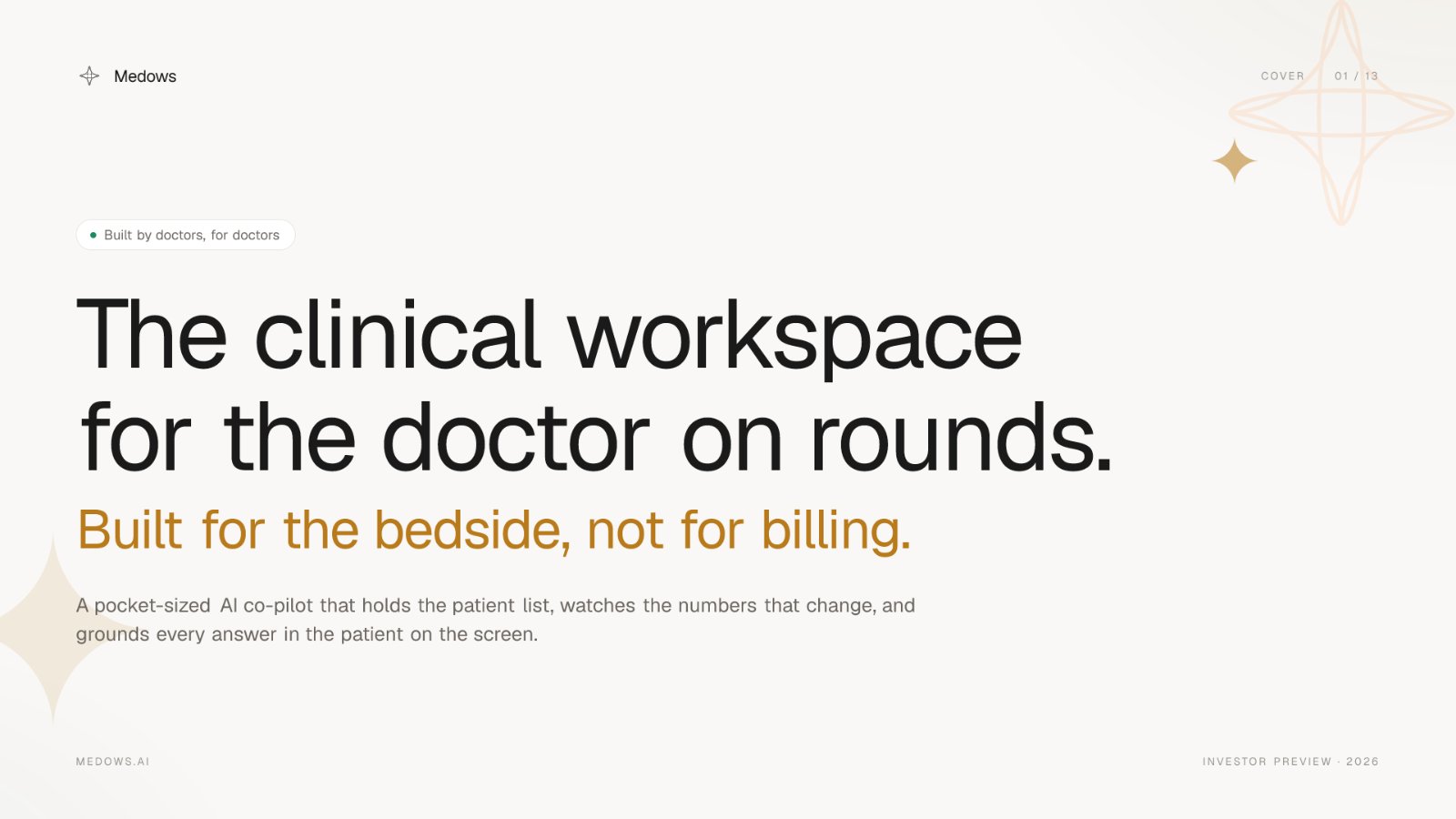
Hyperkalemia at 2 a.m., quiet sepsis on a Sunday morning, a drug interaction caught at order time, and a handover that didn't drop the pending lab - four composite cases from Indian wards showing how Medows actually works.
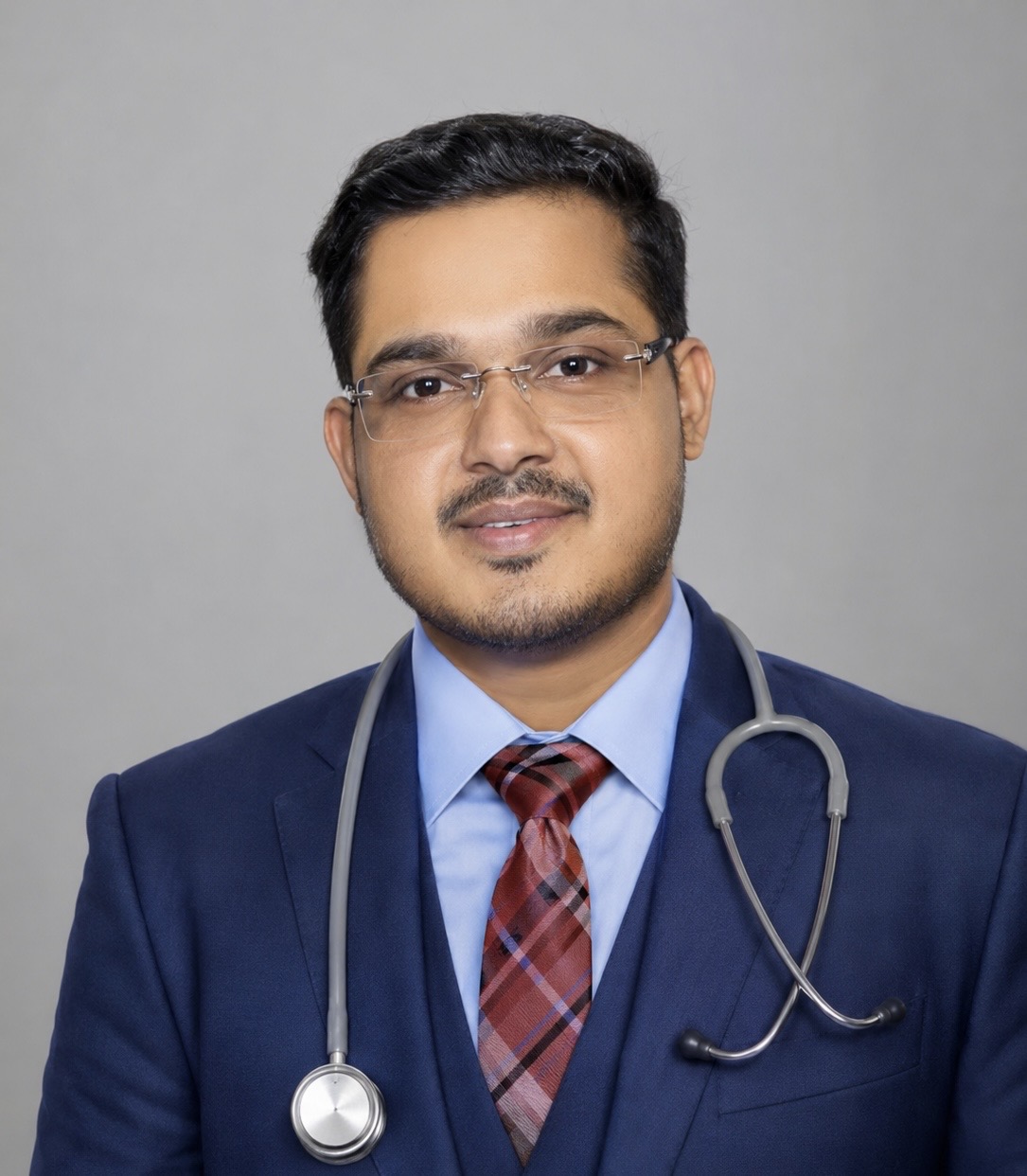
Dr. Soumyadeep Adhikari, MBBS, MD
PGT General Medicine, RG Kar Medical College
The first time I watched a colleague hand over his ward, it was 2:18 a.m. He had a folded sheet of paper in his coat pocket — names, bed numbers, two-letter shorthand. Twenty-seven patients. He spoke at the speed of someone who had done this for years, but I could see him glance at the paper between every patient. The handover took eighteen minutes. By the end, the doctor receiving it was already reaching for his own folded sheet.
That was the moment that made me believe the ward needed software of its own.
We didn't build an EHR. The hospital had an EHR — a documentation system, not a working surface. What the doctor on rounds needed was somewhere to hold the work between the bedside and the chart. Vitals between beds. An AI that already knew which patient was on the screen. A handover that wrote itself from what actually happened in the shift.
What follows are four composite cases — not real patients — that show what Medows looks like in actual use. They're written to demonstrate capabilities, not to oversell. Names and identifiers are invented.
Case 1 — Hyperkalemia at 2 a.m.
Bed 4 · 62/M, CKD on furosemide and spironolactone, admitted with decompensated heart failure.
The night nurse calls. The 10 p.m. routine bloods just came back. The K+ is 6.4. She's read the report on her phone but the patient is in a side room and she wants the doctor to come look at the ECG.
The PGT opens Medows on her phone as she walks. Bed 4 is already pinned to the top of the ward list — flagged amber from the morning when his urine output dipped. She taps the bed. The ECG photo from the nurse is there, attached to the patient row from twenty minutes ago. Peaked T-waves in V2–V4, no widening yet.
She taps Ask Medows: Best initial step for K+ 6.4 with peaked T-waves?
The reply isn't textbook prose. It's specific to the patient:
For this patient (K+ 6.4, ECG with peaked T-waves V2–V4, eGFR 28):
- Calcium gluconate 10 ml of 10% IV slow push — membrane stabilisation
- Insulin–dextrose: 10 U regular + 25 g D50 over 30 min
- Recheck K+ in 1 h, repeat ECG
- Hold spironolactone. Furosemide can continue.
Citations sit at the bottom: AIIMS Hyperkalaemia protocol, ICMR Critical Care.
She gives the orders. By the time the senior arrives at 3 a.m. she has the K+ recheck on screen — 5.4, T-waves softening. The senior reads the chart and the Ask Medows transcript side-by-side. There's no ambiguity about what was given, when, and why.
What Medows did: held the patient's full context (CKD, recent dip in output, ECG photo, active medications), answered in patient-specific terms, cited the source. The PGT did the medicine.
Case 2 — Quiet sepsis on a Sunday morning
Bed 9 · 71/F, post-op day 2 after cholecystectomy. Vitals "stable" on every individual check.
This is the case that proves the value of a workspace, not a search engine.
Each individual vital was fine. 9 a.m. round: HR 84, BP 124/76, SpO₂ 97%, temp 37.2°C. 1 p.m. round: HR 91, BP 118/72, SpO₂ 96%, temp 37.7°C. 3 p.m. round: HR 96, BP 110/70, SpO₂ 94%, temp 38.1°C.
No individual number triggers a paper-based alarm. But on the Medows trend strip, the line is unmistakable. Heart rate drifting up. Saturation drifting down. Temperature climbing. The card shifts from green to amber at the 1 p.m. recording, then to a soft red at 3 p.m. — not because of any threshold, but because the slope is wrong.
The PGT sees the amber on the ward card while he's walking past her bed. He stops, looks at the trend, asks Medows for the early sepsis differential for a post-op day 2 patient with this trajectory. The response includes blood cultures from two different sites, lactate, urinalysis, a fluid challenge, and a flag to call surgery about possible bile leak.
The cultures grew. The bile leak was confirmed at re-look surgery the next morning. She went home on day 9 instead of being escalated to ICU on day 4.
What Medows did: noticed a slope no individual reading would have flagged. The PGT did the rest.
Case 3 — A drug interaction caught at order time
Bed 12 · 78/M with hypertension, type-2 diabetes, atrial fibrillation, on warfarin for four years. Admitted with a surgical site infection.
The on-call resident is about to add metronidazole. It's the obvious empirical choice. He could prescribe it without thinking. He's tired enough that he might.
He types the order into Medows. The order list updates. Below the new order, a soft amber line:
Possible interaction: metronidazole + warfarin. INR may rise within 3–5 days. Consider azithromycin if anaerobic coverage is not essential. Otherwise: drop warfarin to ½ dose, check INR daily, hold warfarin if INR > 4.
Three details matter here. Medows didn't pop a modal. It didn't block the order. It surfaced a single sentence of context next to what the doctor was about to do, because it already knew warfarin was in the active medications list. The resident reads it, switches to azithromycin, moves on.
If this were a search engine, he would have needed to remember to check for the interaction in the first place. If this were a paper system, he'd have needed to flip to a separate medication chart. The interaction check happens automatically because the AI consult and the order list live in the same surface.
What Medows did: held the patient's medication list and surfaced an interaction at the moment of decision, not in a chart review three days later.
Case 4 — The handover that didn't drop the pending lab
Bed 16 · 45/M, admitted at 9 p.m. with DKA. Sugar 480, ketones 4+, pH 7.18.
At 11 p.m. the resident sends an ABG and orders hourly capillary blood glucose. At 1 a.m. she's pulled into a code in the next ward and the rest of the shift becomes a blur. At 2 a.m. she's writing the handover.
This is the moment ward work usually fails. Twenty-eight patients to summarise in eight minutes. The DKA patient's 11 p.m. ABG hadn't come back yet. There's no field on paper to capture "pending lab — will return around 3 a.m. — alert me if pH falls further."
In Medows the handover for Bed 16 had auto-composed itself from the shift:
Bed 16 · 45/M · DKANow: Insulin infusion at 6 U/h, hourly CBG, K+ replacement in IV fluids.
**Pending: 11 p.m. ABG awaiting result — alert if pH worsens. Repeat ketones at 03:00.
The receiving doctor saw the line at 2:14 a.m. The ABG returned at 3:08 a.m. with pH 7.09. She caught it. By 3:30 the bicarbonate conversation had happened with the senior. By 5 a.m. the trend was reversing.
If the line had been missed — if the pending ABG had been a head-note in the outgoing resident's memory — the next blood gas would have been the 8 a.m. routine. Five hours later.
What Medows did: composed the handover from the actual shift events, including the things the resident had no time to remember.
What Medows isn't
It is not an EHR. It is not a substitute for the hospital chart. It does not replace the senior or the consultant. Every AI answer sits next to the patient context it used, so the doctor can verify before acting. The product is decision support, not decision-making.
It is also not a hospital-wide tool. Medows lives on the individual doctor's account. Each patient list is theirs, scoped to their sign-in. There's no admin dashboard, no shared workspace, no audit log a hospital can pull. We picked that on purpose — it's the surface for the doctor doing the work, not the institution observing them.
Try it
Medows is free for individual clinicians. If you carry twenty patients overnight and you've been doing it on paper, try it on your next shift: medows.ai.
If you're a doctor who wants to co-author a post here — your case, your byline, your photo — write to alapanx@gmail.com.
Author
Dr. Soumyadeep Adhikari, MBBS, MD
PGT General Medicine, RG Kar Medical College
MBBS from Calcutta Medical College. Currently a post-graduate trainee in General Medicine at RG Kar Medical College, Kolkata.
Medows is a clinical AI workspace for the doctor on rounds. Learn more or write to alapan@medows.ai / alapanx@gmail.com.